
From intake to a claim your biller can file.
Your programs, run in one place. Your biller files under your own NPI.
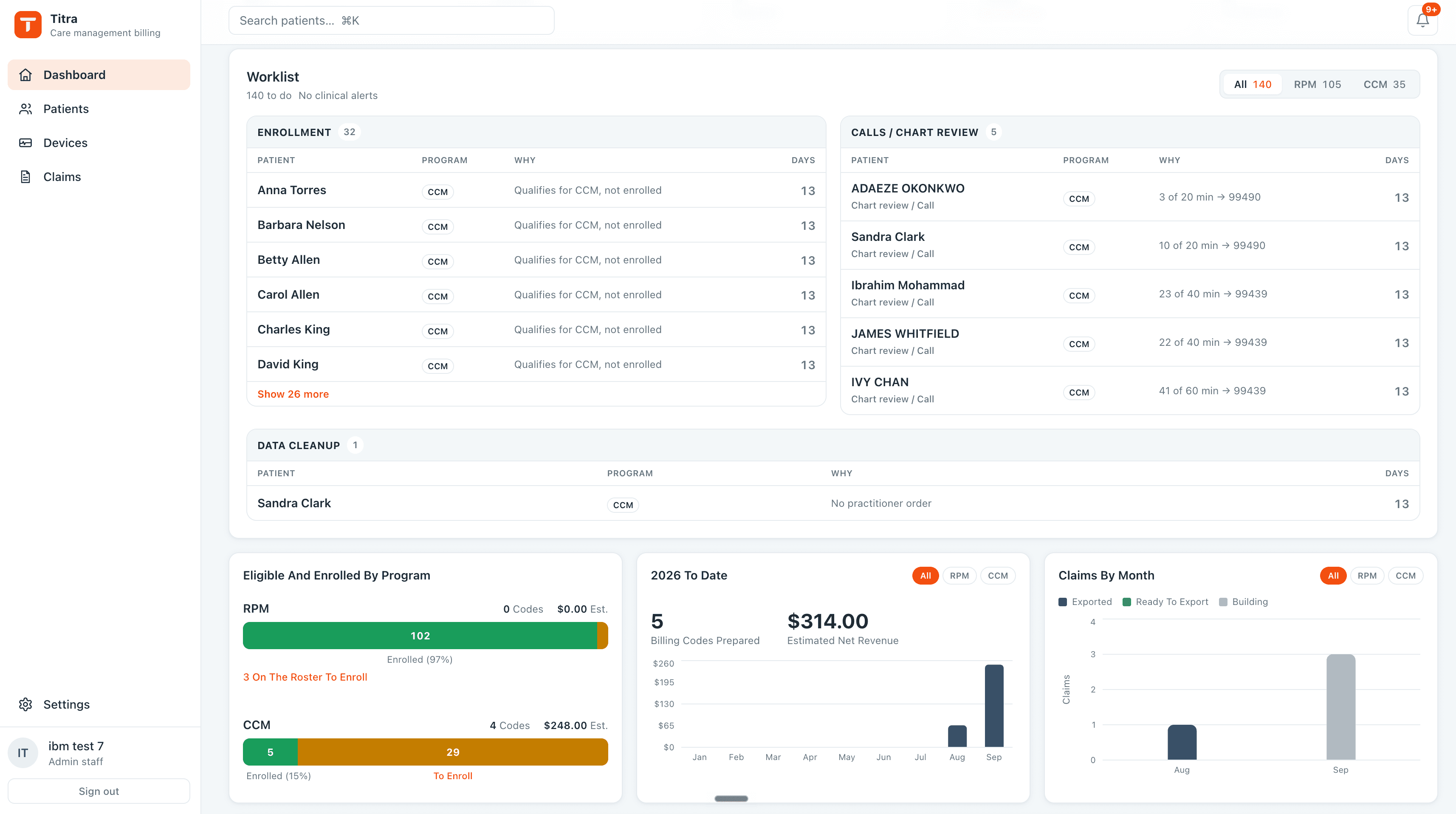
Two programs, one system.
Where the AI earns its keep
Nobody quits CCM because of the patients.
They quit over the minutes nobody logged and the notes that say nothing a year later. Your staff make the call. The write-up is waiting for them when they hang up.
The questions are waiting when the chart opens
What was left open last month, what this patient’s conditions need asked about, and whether the scale has gone quiet. One list, in the order to work it, so nobody is reading four tabs with a patient on the line.
- Your practice’s own questions, in your own wording
- Upload the protocol you already use, as a Word file or a PDF, and its questions join the list
- Questions only. The clinical judgment stays with whoever is holding the phone
- On a bad day for the internet, the list still builds
Dial from the screen and stop taking notes
Calls go out from the browser with your clinic’s number on the patient’s phone. Everything said is recorded and written up as a transcript that keeps the two voices apart, so nobody has to work out afterwards who said what.
- A searchable transcript on the chart, with the audio behind it
- Enrollment calls can be placed for you, in a real voice, and a nurse listens back and signs off on the answer
- The call’s length arrives as a time entry to confirm
The write-up is waiting at the end of the call
A draft appears in the chart on its own: what the call was about, what was decided, what is still open. Whoever made the call reads it, fixes what needs fixing, and signs. Ten minutes of typing becomes about ninety seconds of reading.
- Each answer filed under the question it answered, so a month of calls reads back as a conversation rather than a wall of text
- Anything on the list that went unasked comes back on the next call
- A note too vague to defend a year from now gets one plain question about what is missing from it
- A short account of what has changed for this patient, ready for whoever opens the chart next
You are still the one signing
Taking on a care management program means taking on an audit you might get three years from now, and the quickest way to make that worse is software confident enough to write notes nobody read. So every draft here waits for a person, and everything that touches a dollar is arithmetic you can follow.
Codes come from counting
Every line on your claim traces back to a date, a minute total and a note you can open and read.
A draft stays a draft
Nothing enters the chart until someone signs it, and a correction later stays visible instead of overwriting what it replaced.
Your patient data stays where it is
Recordings, transcripts and summaries sit under the same agreement that covers the rest of the chart.
It keeps working on a bad day
When something upstream goes down, the agenda, the care plan and the counting carry on without it.
Revenue estimate
Estimate what a panel like yours is worth.
Remote monitoring
Distinct days the scale transmits, per 30 day period.
Staff time on what the device sent, per patient per month.
Chronic care management
Clinical staff time per patient per calendar month.
Monthly program revenue
$13,884
$116 per enrolled patient, per month
Codes earned
- 99454Device supply, 16 to 30 days$3,647
- 99457Treatment management, first 20 min$3,624
- 99490CCM, first 20 min$6,613
- Annualized
- $166,607
- Month one with set-up
- $15,404
CY2026 Medicare national non-facility averages. Your allowed amounts come from your own fee schedule, your locality adjustment and the payer at claim time. Staff time and Titra’s flat per-patient fee come out of this figure.
How it works
Four steps, and only one of them is yours daily.
 01
01Roster
Qualifies for CCM, not enrolled
Start from your panel
Your AdvancedMD patients come across with their diagnoses, and the ones who qualify are already marked. Nobody works down the list chart by chart.
 02
02Shipment
Delivered, ready to use
Enroll
Consent, the care plan and the ordering provider in one pass. Patients who need a device get one at their door, ready to use out of the box.
 03
03Care time
18 of 20 min toward 99490
Work the month
A short daily list of who needs something. Your staff talk to patients, and the minutes and the notes record themselves around them.
 04
04Claim
99490, evidence attached
Hand off the claim
The month arrives as billable lines with the paperwork behind them. Your biller files it under your NPI. We never touch the submission.
Also in the box
The unglamorous parts, already built.
Daily worklist
What an NP or MA does today, in order, and short enough that it actually gets worked.
Device logistics
Where every device is, who has it, and a prepaid box home when a patient leaves the program.
Browser calling
You are already on the line by the time the patient’s phone rings.
Call review
Recording, transcript and a drafted note attached to the encounter, so the minute log has something behind it.
Care plans
Started at enrollment, updated as things change, and never the thing holding up a month.
Your fee schedule
Your own prices per payer, turned into a superbill your clearinghouse takes.
Evidence packets
Per patient, per month, per code. When someone asks, the answer is a file.
Answerable access
Who opened which chart, and when, is a question with an answer.
No. Titra takes the program from intake to a generated claim with its evidence attached, and your biller files it under your own NPI. We are the software in between, never the billing party.
See it against your own panel.
Thirty minutes, screen shared, your diagnoses and your payer mix. We will tell you plainly whether the programs are worth running at your practice.