
The platform
Intake to claim, in one system.
Most practices run care management across an EMR, a device vendor portal, a shared spreadsheet of minutes, and a biller’s inbox. Every hand-off is a place revenue and evidence go missing. Titra Health is the one surface where the program actually lives.
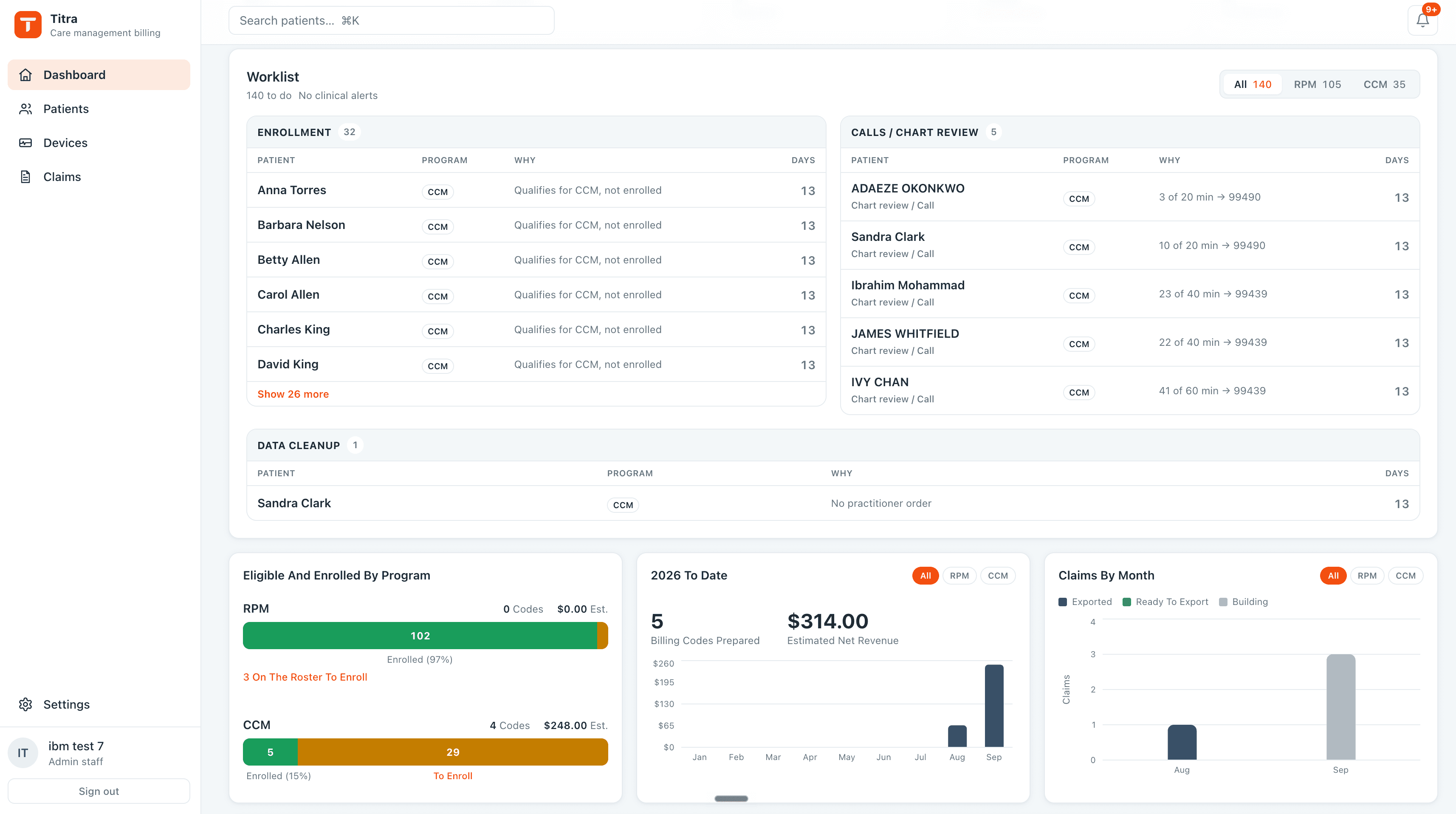
The shape of a month.
Enrol the right patients
Upload the practice’s export. Titra Health reads the diagnoses and tells you who qualifies for what. Staff record consent and the ordering provider; nothing ships before that.
The device shows up and just works
A cellular scale is drop-shipped to the patient’s home. No smartphone, no app, no Wi-Fi, no pairing, no account. They step on it and the reading transmits itself.
Your team monitors and documents
Readings land in the chart on arrival. Thresholds raise alerts, the worklist orders the day, and every minute of review or conversation is logged to the patient with an author.
The month closes into a claim
The nightly engine counts transmission days and completed minutes, recommends the codes that actually qualify, and hands your biller a frozen packet with the evidence attached.
From roster to enrolled, one patient at a time
Import the practice’s patient export, and Titra Health works out which programs each patient actually qualifies for from their diagnoses — instead of asking staff to guess.
- CSV intake matched on chart number, then name and date of birth
- Program fit derived from ICD-10s, with a warning when CCM’s two-condition gate is not met
- Consent and the care plan written in the same transaction as the enrolment
- Coverage re-verified monthly; a plan change flags the patient instead of dropping them
Readings arrive by themselves, and gaps surface early
Cellular devices transmit straight into the chart. Per-patient thresholds raise alerts, and a patient who stops transmitting becomes a task before the billing window closes.
- Vendor-agnostic ingestion behind one adapter — Smart Meter, BodyTrace, Tenovi
- One live alert per patient per rule, with occurrences, so nobody drowns in duplicates
- A caution that becomes critical escalates in place and wakes a snoozed alert
- Alerts are never auto-closed — every one gets a documented human response
Minutes that are attributable, append-only, and never silently edited
Time is logged against the patient with who did it and what they did. Corrections void and re-insert with a pointer back; the table has no UPDATE or DELETE.
- Role-aware: only physician and clinical-staff minutes count toward 99457 and 99490
- Calendar-month bucketing in the clinic’s own timezone, never a UTC string slice
- Talk to patients through the browser — they see the clinic’s number
- A pre-call plan that weaves open follow-ups, condition prompts and device questions into one agenda
Claims your biller can defend line by line
The compliance engine computes eligibility nightly. Every billing line carries the evidence behind it — identity, enrolment, consent, diagnoses, and the service record for that code.
- Transmission-day counts over rolling 30-day device-supply episodes
- Monthly batch submission with a coverage gate that stops claims, not monitoring
- Frozen monthly snapshots — a re-download months later is byte-identical
- Per-patient evidence packets and a clinic roll-up CSV, chart-ready
The actual screens
Not a slide deck.
These are screenshots of the running product. The patients in them are seeded and fictional — invented names, invented addresses, a database that has never held a real chart.
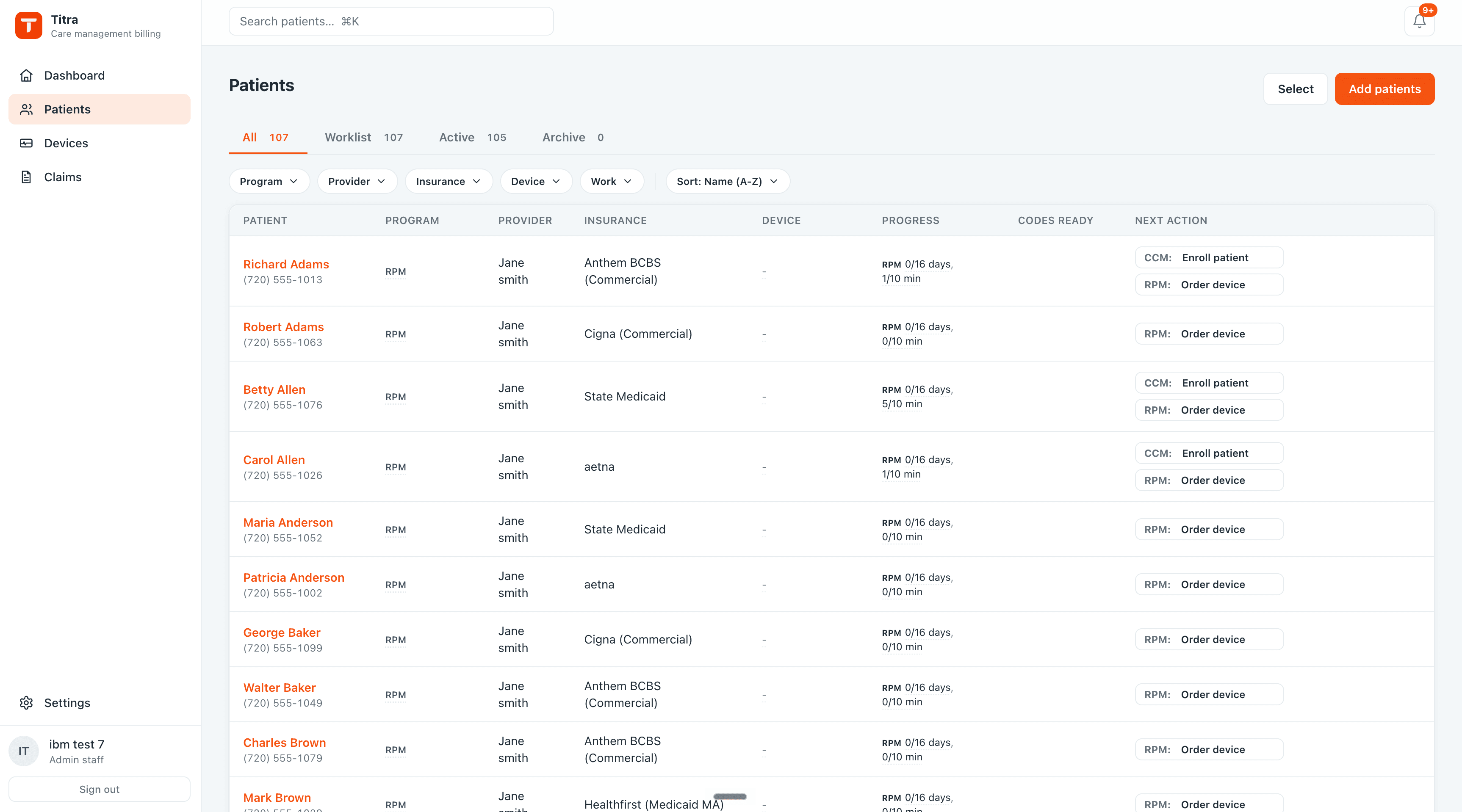
Roster
Everyone on the programme, and what each one needs next
Filter by programme, provider, insurance, device or outstanding work. Each row carries its progress against both thresholds and the specific next action — enrol, order a device, make the call.
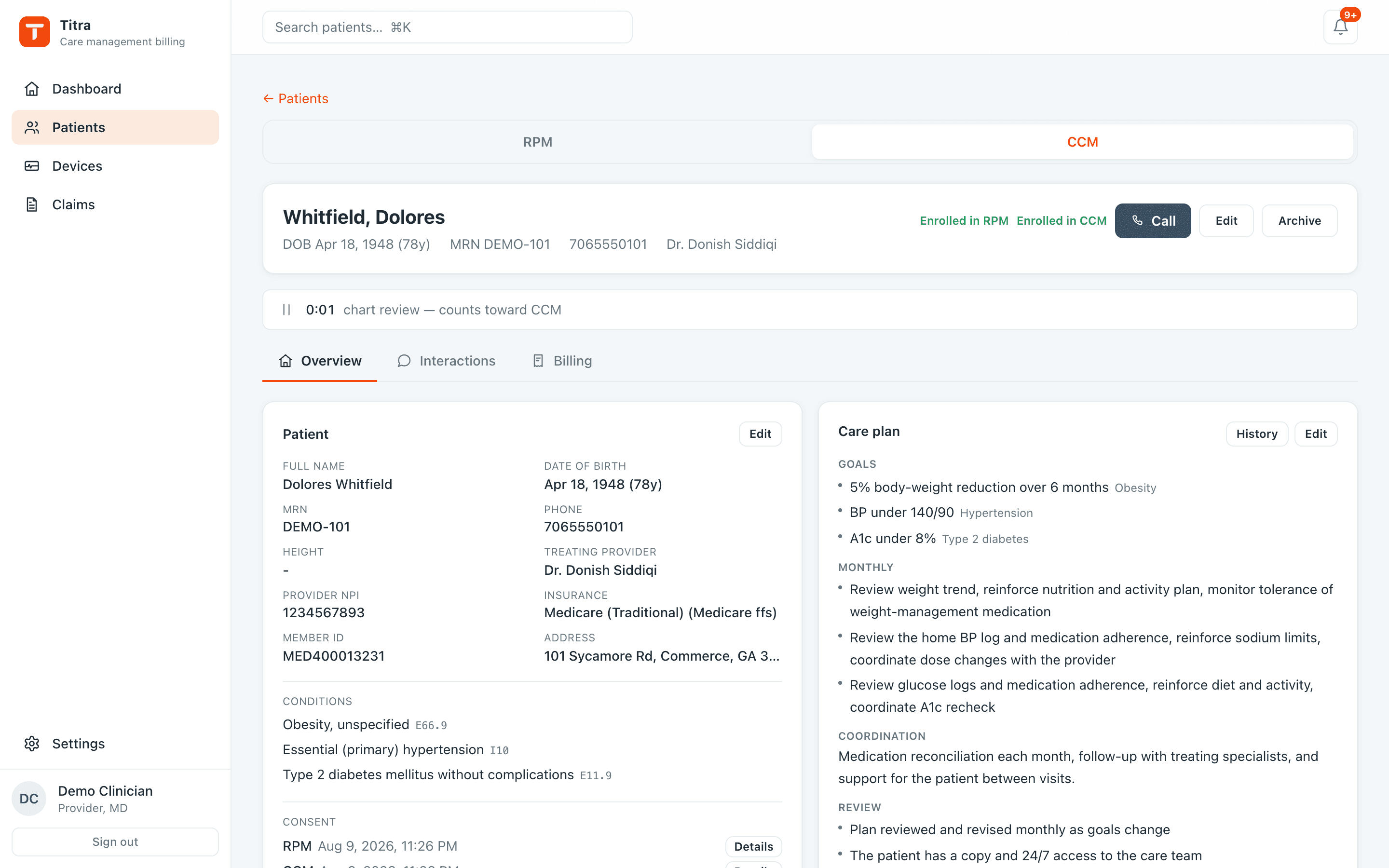
Patient chart
One chart carrying both programmes and the evidence behind them
Enrolments, the comprehensive care plan with its goals, coded conditions, and the consent record with the date it was taken. The chart-review timer at the top logs the minutes you spend here against the right programme.
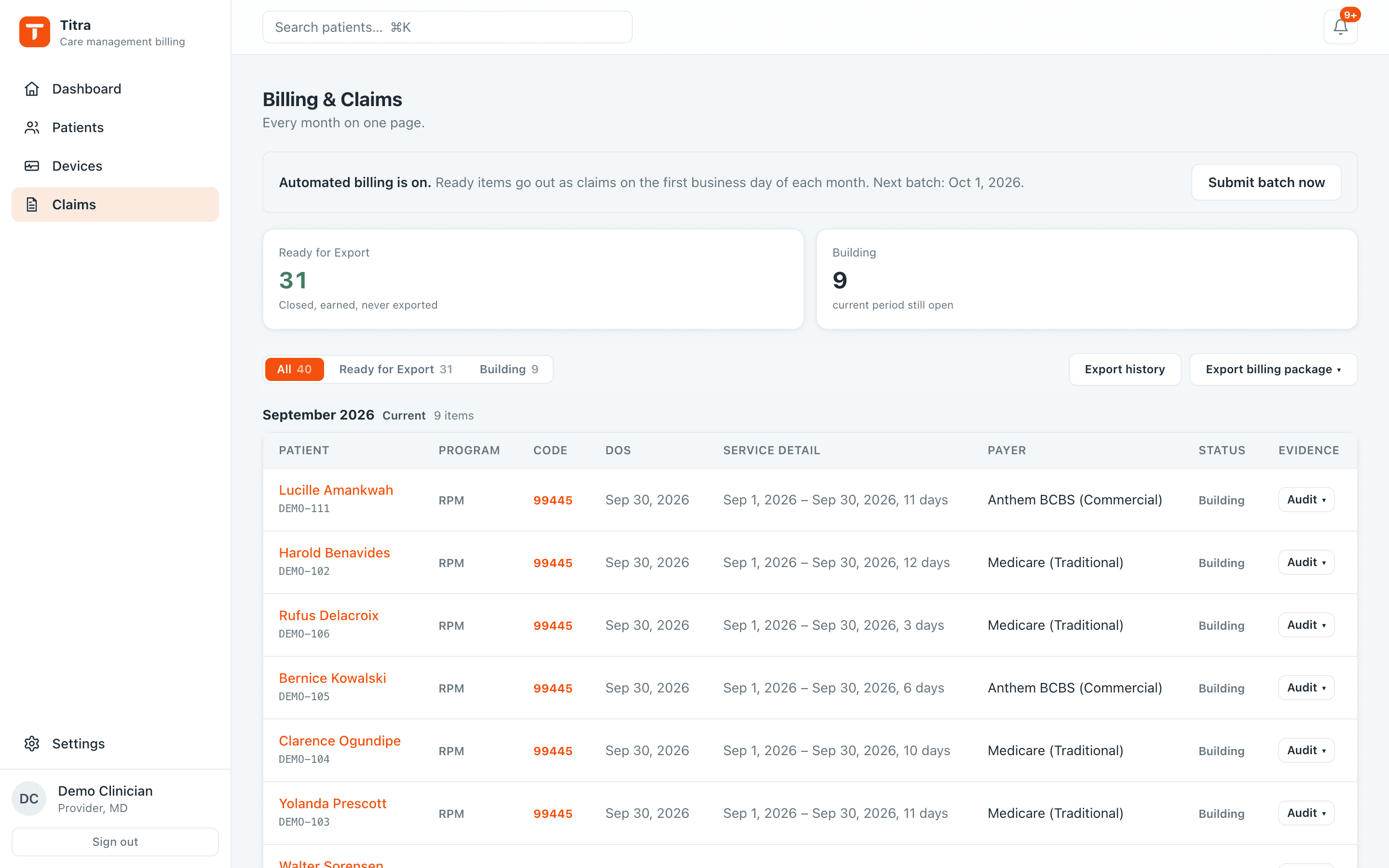
Billing & claims
Every line, the days behind it, and the evidence attached
The month on one page: the recommended code per patient, the transmission-day count that justifies it, the payer, and an audit action that opens the evidence packet for that specific line.
Devices
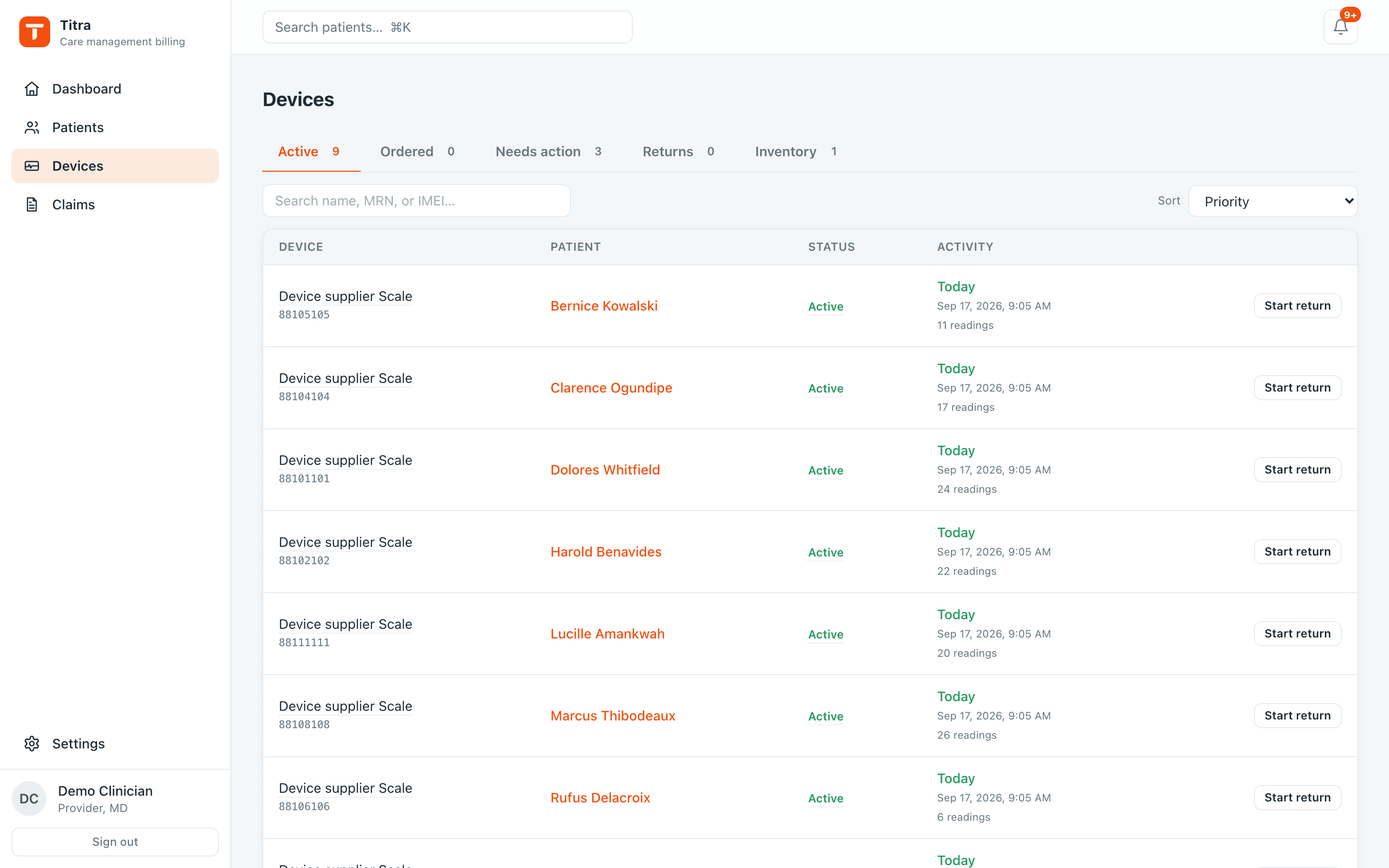
The fleet, from order to return
Inventory through shipped, delivered, active, returned and faulty — with the unit currently out, how it reached its patient, and how many patients it served before them.
Reports
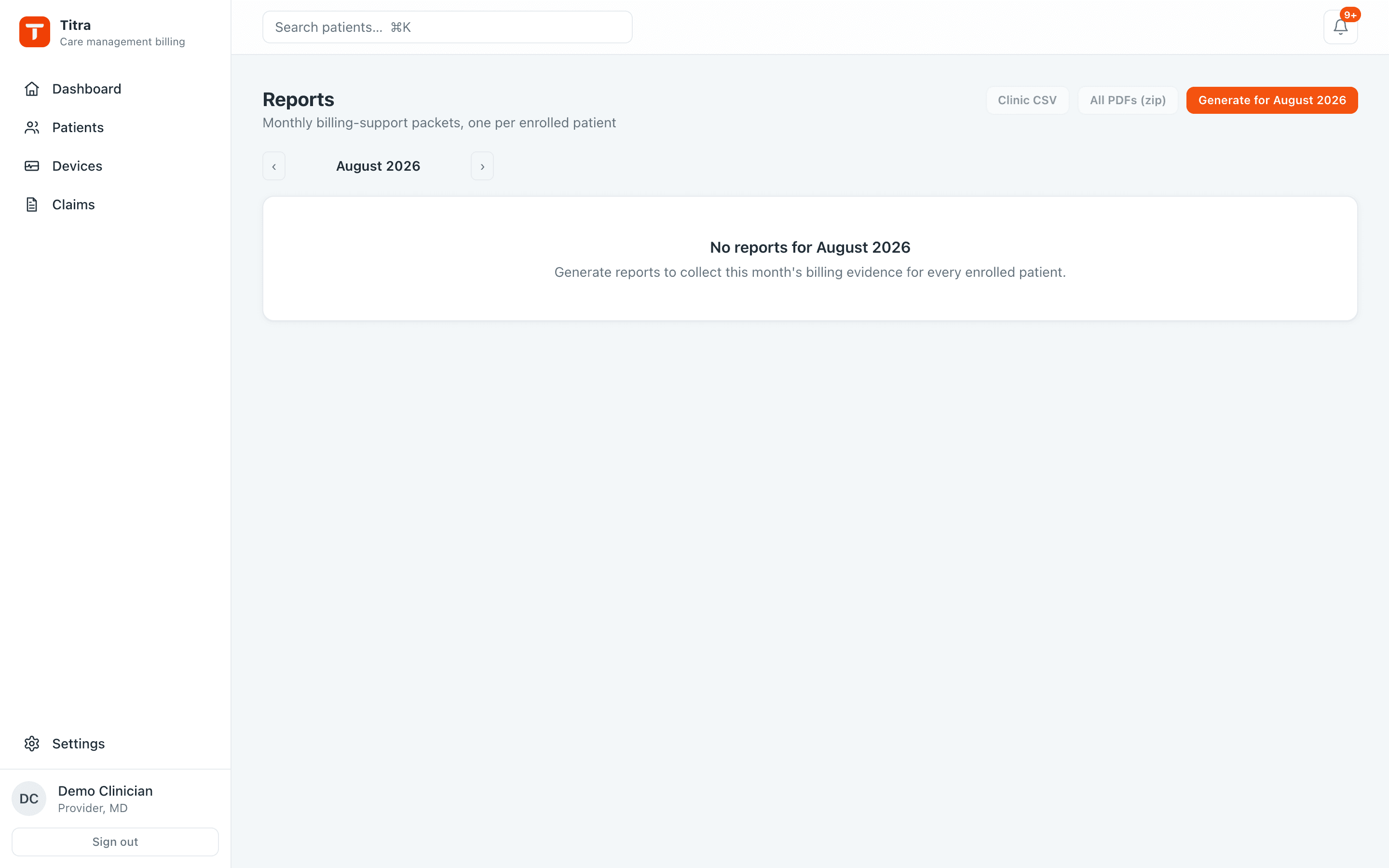
A frozen snapshot your biller can work from
Monthly packets render from frozen snapshots, so a re-download months later is identical: per-patient PDFs and a clinic roll-up CSV, chart-ready.
Everything else
The parts nobody demos, already built.
Daily clinical worklist
What an NP or MA does today, in the order they should do it — and short enough that it actually gets worked.
Device logistics
Inventory through shipped, delivered, active, returned and faulty, with tracking and a prepaid return path on disenrolment.
Browser-based calling
Single-leg WebRTC calling. You are already on the line by the time the patient’s phone rings.
Call review
Recording, transcription and analysis attached to the encounter, so the minute log has something behind it.
Care plans
A version-tracked comprehensive plan per patient, seeded at enrolment and required before a CCM month bills.
In-app guide
A help panel that knows which screen you are on and nothing else — the route is normalised before it ever leaves the tab.
Charge master & superbills
Your own fee schedule per payer, rendered into a superbill and a claim your clearinghouse accepts.
Access audit
Every PHI read is logged per recipient. Mandatory MFA on every account, and an append-only auth event trail.
Under the hood
Boring architecture, on purpose.
A care-management program is a compliance artifact that happens to have a UI. The interesting engineering went into making the arithmetic impossible to fudge.
Separate by design
The clinic program runs in its own isolated environment holding clinic data only — a deliberate split from Titra Health’s consumer product, which never learns which patients are in a clinic program.
Multi-tenant from day one
Every table carries a clinic identifier and every query is scoped to it, so one practice can never see another’s chart.
Vendor-agnostic devices
Ingestion sits behind one adapter interface. Adding a vendor, or a second parameter such as a blood-pressure cuff, does not touch the compliance engine.
Deterministic where it counts
Code eligibility, transmission-day counting, minute arithmetic and alert thresholds are pure functions with a unit-test suite around them. No model decides what is billable.
Walk through it with your own panel.
We will screen-share the real dashboard, not a slide deck.